This D&D-inspired card game balances big swings with strategy designed to reward smart decisions
Trick-taking games are enjoying a moment in the tabletop space right now, with several top games exploring cooperative trick-taking elements. Typically, trick-taking games are highly dependent on the draw of the cards. Some games have ways to mitigate weak hands, but very few games can totally negate the power of a strong hand. For better or worse, luck remains a key element of the trick-taking genre, no matter what the surrounding rules are.
Crits & Tricks doesn’t shy away from the randomness and luck of trick-takers. However, players are ultimately left to build their own luck. Players combine a hand of cards that represent suit only and couple them with differently sized dice. Each suit has its own win condition, meaning that rolling low at the start of the game isn’t necessarily a game-ender. Plus, if you’re unhappy with the value of a die, you can always play it and choose to re-roll it, giving you a second chance to change your luck.
Although chance plays a big role in Crits & Tricks, the game invites players to constantly test their luck for better or ill.
Crits & Tricks features & design
Ages
10+
Game type
Trick-taking
Players
2-4
Lasts
20-40mins
Complexity
Moderate
Designers
Pete Wissinger
Publisher
Inside Up Games
Play if you enjoy
Lord of the Rings Trick-Taking Game, The Crew
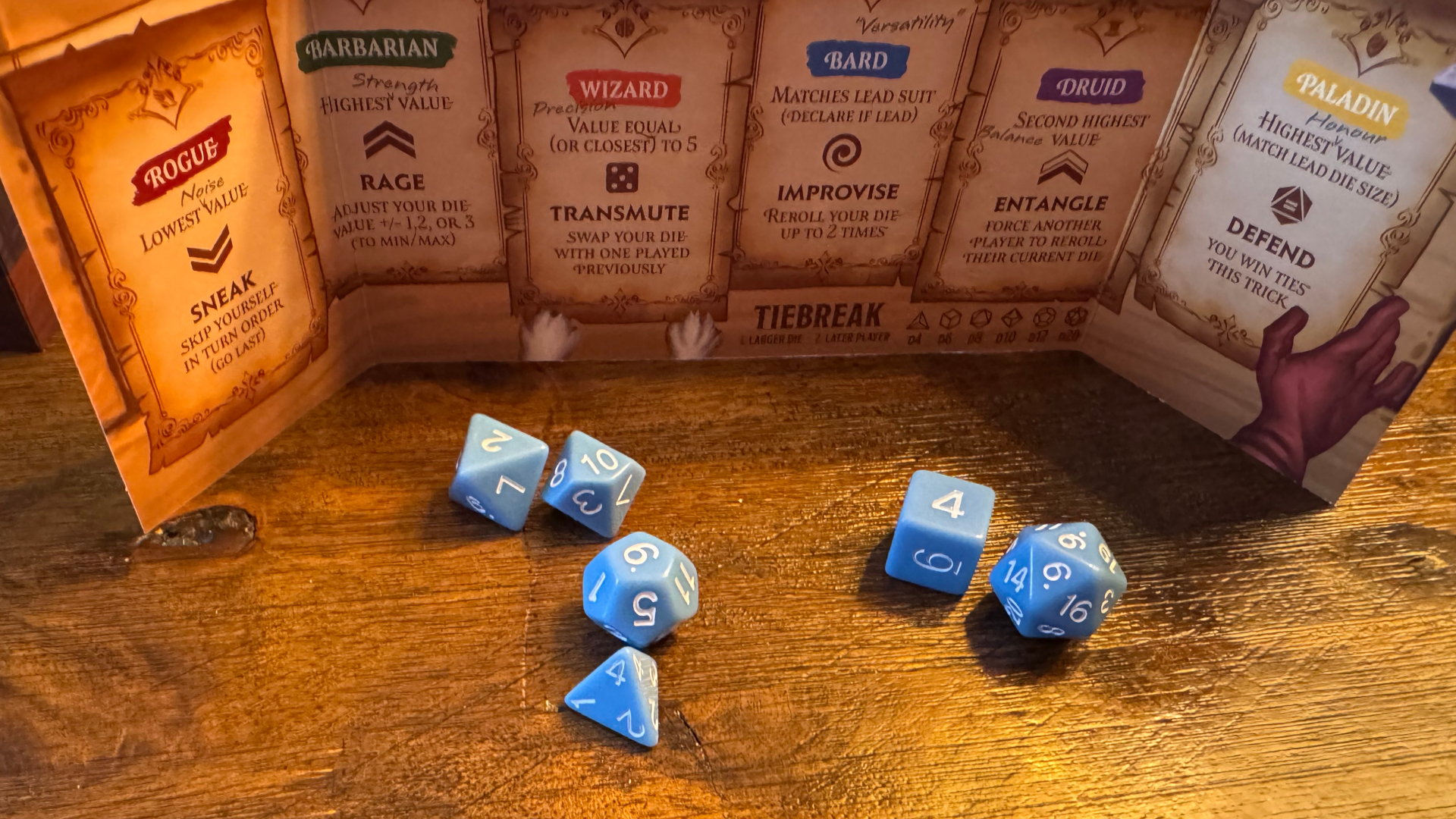
Crits & Tricks is a combination card and dice game that wears its Dungeons & Dragons influences on its sleeve. Each player has a set of dice from D&D and the best tabletop RPGs ranging in size from a D4 to a D20, which they will roll at the start of the round. Each player also has a miniature screen reminiscent of a DM Screen that they use to obscure their unplayed dice from other players.
The Crits & Tricks game deck consists of six different suits of cards, four of which will be used in every game. Each suit is named after a different D&D class and two sets of rules – one dictating their CRIT ability and one dictating the suit’s win condition when played to lead the round. Critically, only the CRIT ability is displayed on the card, so players will have to remember the suits’ win conditions or refer to their DM screen. One suit – the Bard – will always be used, but the other three suits can either be chosen at random or deliberately selected to create different gameplay variations.
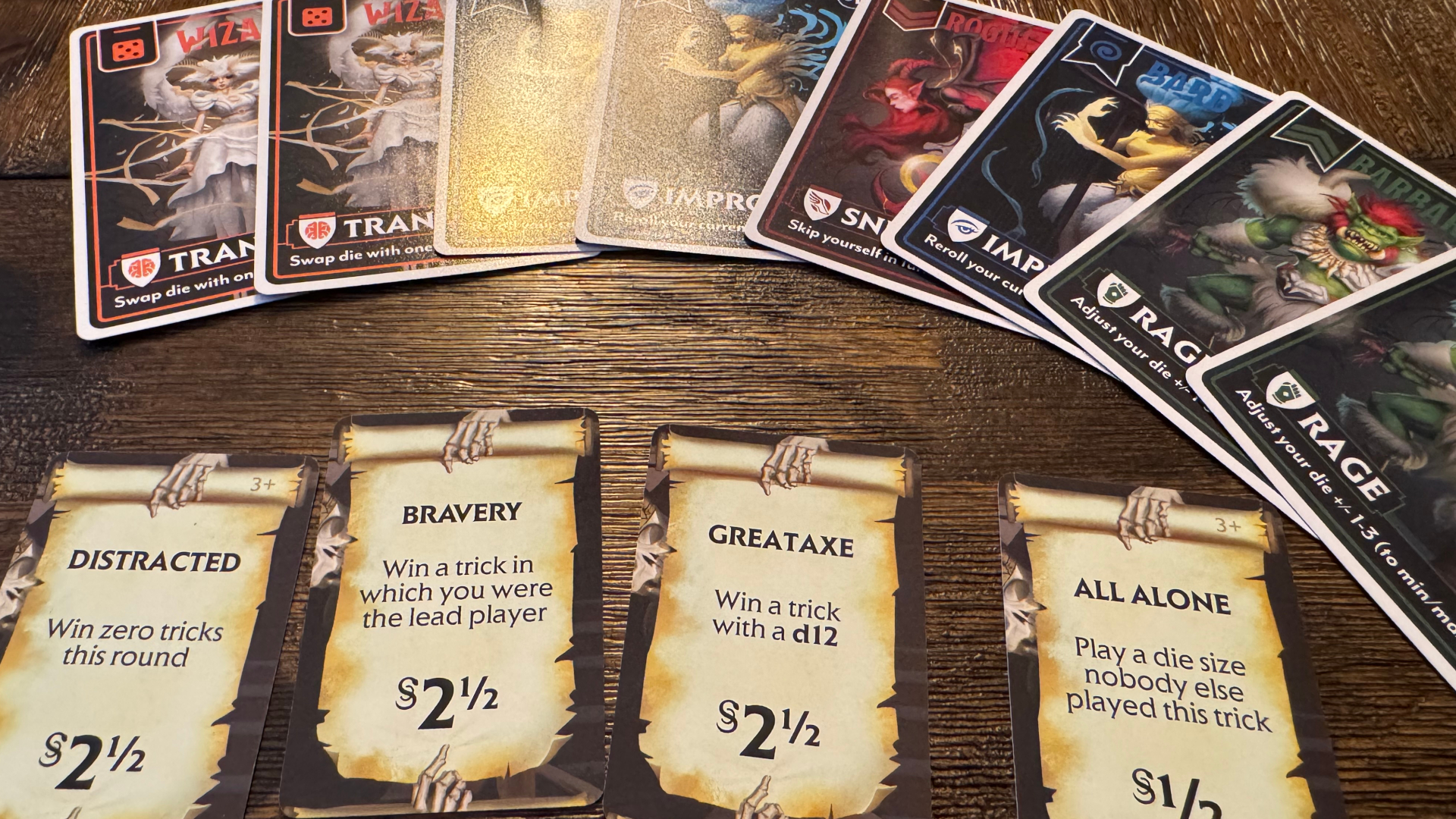
In addition to the individual dice and the shared suit of cards, players will also use a deck of quest cards and a set of four barkeep challenges. The quest cards are individual challenges that players can try to complete for points and range from collecting a specific number of cards for a specific suit to avoiding certain cards for the entire round. Some quests can be completed during a round of play and can immediately be turned in for points. Other quests require the full round to play out. The barkeep challenges represent an additional win condition that all players can complete for additional points.
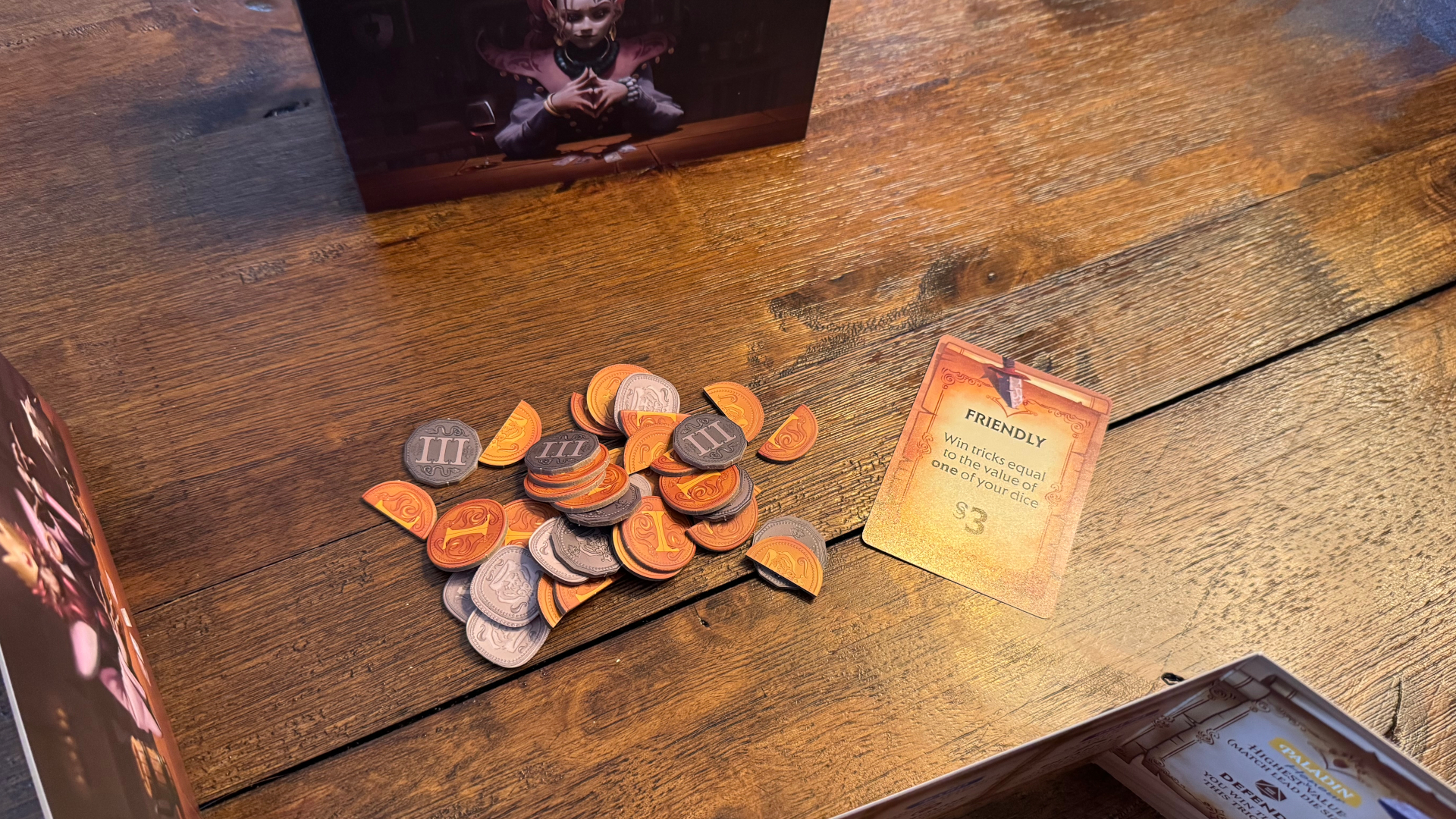
Victory points are represented via loot, which comes in the form of both coins and various magic items. Collecting a magic item doesn’t result in additional benefits, but they’re more fun to collect than a standard stack of coins.
Each round lasts six tricks, with players collecting loot throughout play and at the end of the round. The game lasts for three rounds, and the player with the most loot ultimately wins the game.
Gameplay
Anyone who’s ever played a trick-taking game will understand the basics of Crits & Tricks. Your general goal in Crits & Tricks is to score the most loot, which is collected by winning tricks and completing quests. Some quests are counter-intuitive to winning tricks, such as playing a D4 dice with a specific suit of cards, so it’s highly unlikely that a player will be motivated to win every trick. Of course, the various values of the dice and the variable win conditions for tricks makes it highly unlikely that a player will win every trick anyways, but sometimes it makes more sense to “lose” a trick to complete a quest because it nets more loot.
At the start of each round, players “summon their strength” by rolling all of their dice behind the screens. Once a dice is rolled, its value is fixed until it is played. However, when the dice is played is left up to the player. Because of the variable win conditions (which reward high values, low values, and even second-highest values), there’s not necessarily a poor set of dice rolls, depending on the suits active during a game. Once everyone rolls dice, four quests are dealt to each player. Every player selects a quest and then passes the remaining quests to the player next to them. This draft selection continues until each player has four quests. Then gameplay starts, with the lead player either being the player with the most loot or the player that rolled the highest on an initiative-determining D20 roll.
Lord of the tricks
Trick-taking has come back into the spotlight recently thanks to a couple of Lord of the Rings card games that use the mechanic. The most recent is The Two Towers Trick-Taking Game, which we adored in our five-star review.
From there, gameplay largely plays out as any trick-taking game would with a couple of key differences. For one, when a player chooses what card to play, they also select a dice and play it on top of the card. If they don’t like the value of their dice for some reason, they can choose to re-roll it and have to take the new result. The lead suit determines the win condition – the Barbarian wants the highest dice value, while the Rogue wants the lowest value. Wizards want a value closest to 5, while Druids want the second-highest value. Paladins want the highest value, but only of whatever dice type was played by the lead player. As a wild card, Bards have no specific win condition but instead take the win condition of whatever card they’re meant to represent.
In addition to choosing what card and what dice to play, players can also choose to activate a CRIT ability. Each player can activate up to two CRIT abilities during a round of play. Some CRIT abilities increase or decrease dice values, force other players to re-roll dice, or guarantee a win during a tie. My personal favorite CRIT ability is the Wizard’s Transmute ability, which allows you to swap a player’s current dice with another dice they’ve already played. This allows a player to really maximize a well-rolled dice.
I also like the decision that comes from activating CRIT abilities. They are pulled out of a player’s hand, ultimately removing a card from future play. Not only does a player need to decide when they play a CRIT ability, they also need to decide whether to play a CRIT ability at all, as it ultimately limits their future options on hands. Playing a CRIT ability early might mean they can no longer have the suit they need for a future hand.
Should you buy Crits & Tricks?
Crits & Tricks uses the trappings of a trick-taking game to hide something that involves lots of quick decisions and strategy. Players aren’t really limited by their hand or dice results. Since players score more points by completing quests rather than taking tricks, it’s all about figuring out what plays will net players the most amount of loot in any given round.
The downside to Crits & Tricks is that there are a lot of moving parts, all of which can make a mess of properly preparing a strategy. A CRIT ability can be negated by another player’s counter, and of course there are times where you simply don’t have the lead suit, which automatically eliminates you from a win. There’s no such thing as a dominant hand in Crits & Tricks, but players can easily be prevented from implementing their strategy, which can lead to them scrounging for loot throughout a round.
Crits & Trick is also a fast-paced game, lasting only three rounds, so players who simply don’t have luck on their size can play another game pretty quickly without much problem. I like that gameplay can differ greatly based on which suits are selected for a deck, and I could see future expansions adding new suits into play without much difficulty or cost. Overall, Crits & Tricks combines strategy and luck in a very satisfying way, making for a game that tests both.
Buy it if...
✅ You enjoy trick-takers with a twist: Crits & Tricks is ultimately a trick-taking game with a lot more decisions to make at every round. Play it if you like a mix of strategy and luck.
✅ You enjoy games that use a lot of the same language as Dungeons & Dragons: Crits & Tricks isn’t a D&D game, but it’s clearly meant to be enjoyed by D&D fans.
✅ You like games where the outcome can change quickly: There’s no such thing as a winning hand in Crits & Tricks, and even a smart strategy can be derailed by other players. If you like games where you’re sitting on the edge of your seat, you’ll like Crits & Tricks.
Don't buy it if...
❌ You don’t like games that are highly luck-dependent: Bad dice rolls can really set you back in Crits & Tricks. While you can always try to re-roll a bad dice result, be prepared to accept that your fate is largely random in Crits & Tricks.
❌ You don’t like a game where the mechanics change frequently: With sixty-four quests and five win conditions for tricks, there’s no real way to come up with a strategy that can survive multiple rounds of play. Be prepared to come up with a gameplan on the fly.
This review was conducted using a product sample provided by the publisher.
For more recommendations on what to play next, be sure to check out the best board games or the best tabletop RPGs.