Celestial Return Review
Choose Your Own Dystopian Adventure
Hard rock and cyberpunk feel like a match made in heaven. The angst and anger built up over a lifetime of feeling downtrodden and hopeless burst out in a sense of rebellion. Metaphor Games’ Celestial Return wonderfully nails the tension-filled angst with a twinge of hope in its world-building and presentation. However, this doesn’t coalesce with the plot or gameplay, creating some dissonance in the dice-powered narrative RPG.
Celestial Return thrusts players into the role of Howard, a veteran of the Paranormal Investigative Division (PID) sent to respond to supernatural events around the metropolis of Netherveil. Located underground, beneath another city, the inhabitants of Netherveil occupy a polluted site of decay and struggle for survival in its fascist society. Its paranormal woes are caused by entities called Abstracts, beings that cause most humans to die upon meeting them. Howard faced them for years, so has become an expert in them. Howard’s team is sent in as cleanup against a particularly murderous Abstract, and while witnessing everything burn around him, he finds and rescues a sentient flower named Rose. Howard looks to impart some hope and knowledge onto Rose, a blank slate, as Rose learns more about humanity as it shapes its morality.
A few years after rescuing Rose, Howard has quit the PID and drinks himself into a stupor most evenings. Occasionally, he dusts himself off to help the police department solve cases with an Abstract angle. His latest case involves three people who were all found dead in ways that indicated self-harm. Howard’s investigation follows a string of clues on a personal and poignant journey through cosmic horror and dystopian cyberpunk, featuring an in-depth societal allegory cautioning against corporate greed and examining the length humans will go to for survival and to hold on to hope.

There is more than meets the eye with Rose.
Celestial Return is broken down into three different acts. The choices that the player makes in the first act carry through to the next one, with the gap in between giving the story a chance to unwind through a heavy metal interlude with a real-life music video. These musical interludes mix in with a cyberpunk cosmic horror motif, taking the harsh lines from a combination of manga and comics to create a powerfully striking overall presentation that oozes raw emotion.
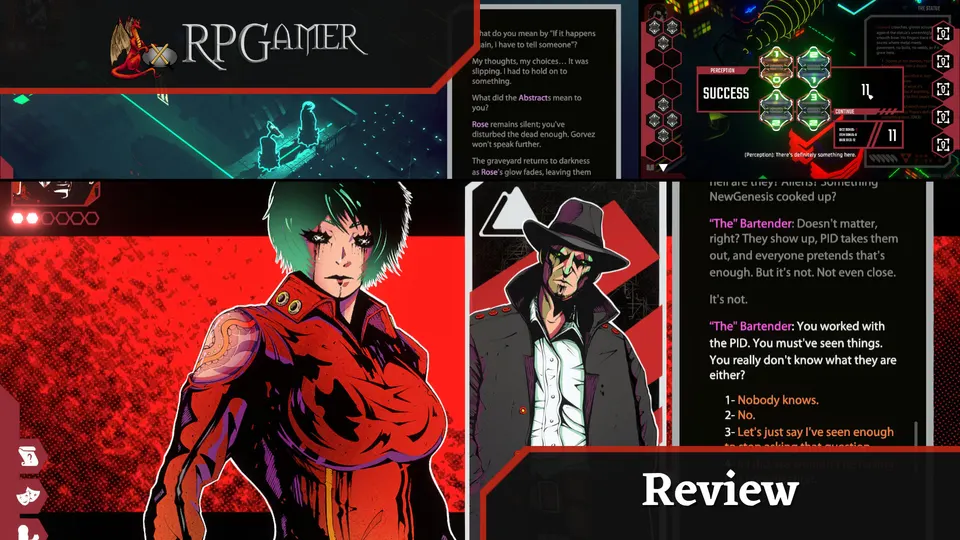
While exploring Netherveil, Howard can come across limited-time side quests that can only be completed before the next major plot location, providing rewards and some interesting worldbuilding. Exploration boils down to clicking spots on the map with the occasional side quest unlocking while moving between spaces. Upon encountering an event, the game shifts from the overview map into large dialogue boxes with character portraits, background scenes, or snippets of video such as raindrops falling into a puddle, depending on the event.
The world of Celestial Return is both alien and familiar to a typical cyberpunk story. Familiarity comes from its dealings with augmented metallic upgrades, turning many people into cyborgs. Its more alien aspects involve people from the world above visiting Netherveil from their place of comfort through the use of robotic shells called Alternated. The use of metals and robotics is a part of everyday life in Netherveil, turning organic material into a symbol that is synonymous with excess, which those in power flaunt. The powerful’s ability to flaunt is possible because they have a lot of dice, which are a stand-in for currency and a meta commentary on survivability. Those who have tons of dice are much more likely to get through scary situations, think more clearly, and have a chance to succeed that isn’t afforded to those who have fewer dice to work with. Abstracts are a boogeyman, but the rumours of their existence have grown louder and give Howard a constant ethereal dread that makes every silent area heavy with tension. Between the cyberpunk and the supernatural, Howard is never safe, even with plenty of dice.

Just an existential conversation between a man and his flower.
Howard isn’t entirely alone in his detective work. His years of trauma have built up a form of split personality, with various voices in his head overlapping, leading to a consistent inner monologue. The voices born from Virtue, Foolishness, Anger Issues, Intelligence, and Perception give extra flavour text to everything that Howard thinks and does. In addition, Rose is still hidden after all these years and acts as a companion. These voices double as skill checks on the majority of choices that Howard makes, while those choices that don’t involve them make use of the augmentations that Howard has, such as an ability to see Abstracts. Howard’s choices can result in experience points; after gaining six, he can level up one of the voices, granting additional dialogue and easier skill checks down the road. Experience isn’t plentiful, so there are thoughtful decisions to be made on which voice to upgrade, especially since they all have moments where they take center stage for part of the murder mystery.
While levelling up can make skill checks easier, everything revolves around dice. Even automatically successful checks require a die to execute. Dice are found by interacting with the city, making checking every optional area important to maximize Howard’s chances of success. Dice can have effects that boost or penalize the final result, spinning sideways before landing on two numbers between zero and three. There are shops where dice can be traded in for temporary items that can boost the result, or permit a re-roll if an unfavourable situation comes up. Finding dice is also not a given, making for a tense choice on when to horde or use them, though establishing early on what sort of personality or build to gravitate Howard towards helps make the game substantially easier.

When decisions are made by dice roll, everything is subjective.
The presentation of Celestial Return is very striking. Every backdrop and quest location has a dark tone to it, but the bleak outlook is always punctuated by a contrasting neon flash. The snippets of real footage, the Alternated, and the odd designs for some of the Abstracts all use colour in unnerving ways. Against the settled stillness of a world drained of its will, the use of colour symbolizes freedom of expression. The bright neon hues bounce between many ideals, sometimes hope, other times an alien sense of dread that threatens to tear the known world apart. It always feels like it is fighting the neat and tidy order that the society has grown accustomed to.
The only real problematic part of Celestial Return‘s presentation is that it does not grey out dialogue choices when the conditions are not met. This results in seeing Howard’s side of the dialogue on everything, including spoilers on information that the player never obtained. The farther players get, the more it takes away from the choice-driven nature of the game, making it appear like many of the options simply lead to the same place.

Colour diluted building backdrops have a pop of neon when the Alternated is on screen.
This expression of artistic design blends into the soundtrack as well, highlighting synth, guitar, and industrial beats to keep the atmosphere unnerving as well as tense. These tense moments are punctuated by the music videos between each book that play powerful heavy metal that highlight strong voices, adding to its theme of rising up against an oppressively stale society. Celestial Return‘s soundtrack hits with a constant feeling of underground resistance and being the underdog that stays constant throughout Howard’s journey.
Celestial Return presents a powerful message that surrounds an interesting murder mystery. However, the overtones from the powerful messaging can feel at odds with Howard’s situation. The reliance on dice succeeds in increasing the tension and getting players to consider their choices, but its impact is dulled by immersion-breaking on the part of the UI. Despite those missteps, the combination of cyberpunk and cosmic horror remains fascinating, and the striking presentation is worth experiencing.
Disclosure: This review is based on a free copy of the game provided by the publisher.
Scores BATTLE SYSTEM
INTERACTION
ORIGINALITY
STORY
MUSIC & SOUND
VISUALS
BATTLE SYSTEM
INTERACTION
ORIGINALITY
STORY
MUSIC & SOUND
VISUALS

Always something interesting happening with the presentation
Blends cyberpunk and cosmic horror well
Howard is a multi-layered protagonist
Not hiding unavailable text choices causes an unintentional lack of weight on player choice
Not accounting for dice properly can lead to disaster quickly
The post Celestial Return Review appeared first on RPGamer.