Adventure Corner ~ Feed the Scorchpot
Welcome to Adventure Corner, a column where members of the RPGamer staff can give their thoughts, impressions, and pseudo-reviews for various adventure titles that don’t come under our usual coverage. Adventure Corner is aimed at delivering opinions on a wide range of titles including visual novels, point-and-click adventures, investigative mysteries, and so forth.
In this edition of the column we take a look at Feed the Scorchpot, a game in which the player must produce annual harvests to fill the belly of a ravenous dragon.

Feed the Scorchpot
Platform: PC Release Date: 08.21.2026 Publisher: Indieformer, WhisperGames Developer: Moravian Steam PageIn recent years, the concept of ‘roguelike’ has expanded far beyond the original Rogue, while retaining many of its core elements: start from zero, pick up stuff along the way, see how far that stuff can get you before your inevitable demise. What’s changed is that game developers have realized that it is not necessarily an RPG genre. It certainly matches well to RPGs, but in many ways it lies orthogonal to the RPGestalt, as it’s more about how a game plays rather than what a game actually is. With that said, Feed the Scorchpot takes the base roguish philosophy and marries it to a design paradigm more closely resembling a board game than anything else.
The dread dragon Baron lays it out to the player in the tutorial, with the best and possibly only voice acting the game has to offer. There is an island, its layout and bounty randomly generated from a random seed, and there is the player’s avatar, who should have read the fine print on the management contract before signing. The job: raise enough crops every year to satisfy the dragon’s appetite. The penalty for failure: the dragon gets fed anyway, with no survivors. Managing the annual tributes for twenty years of ever-increasing demands is counted as a win for the player, though they can choose to continue for as long as they can manage, either for high scores or to meet the esoteric requirements for further unlocks.
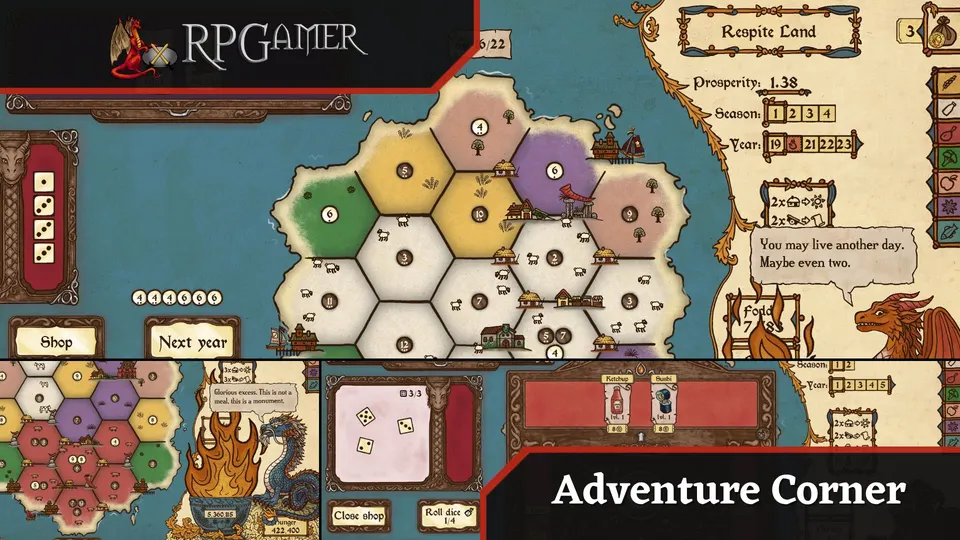
Survival requires a combination of luck and management. Luck determines the layout of the map resource tiles, based on the random seed, and the results of the player’s rolls every round for dice to use. How these tiles and dice are used is up to the player. First, in order for resources to be accessible, there need to be farms placed at the intersecting points where tiles meet. The number of buildings the player can place increases with each year-round, and extant buildings provide golden ducats annually to help pay for things in the shop.

Second, the resource tiles need to be activated, and this is where the dice come in. Each tile has a number mark, from 2 to 12. The player gets a limited number of rolls each seasonal turn of the year-round, with a Yahtzee-style rule that lets them keep any dice they want and re-roll the rest until they either have the numbers they need or run out of rolls. Adding any two dice together gives sums which activate the corresponding number marks on tiles. In the tutorial, the player will roll a 4, a 5, and a 6. This gives the sums 9, 10, and 11, activating the matching tiles. It is specifically mentioned and recommended to roll and choose dice before placing new farms for better strategic placement, but once farms are set, they can’t be relocated. Most of the time, careful cherry-picking of dice rolls is key.
Aside from farms, there are also trading posts, ports, and shrines available, each of which provide their own boosts to productivity depending on where and how they’re placed. As the game progresses, upgraded versions also become available via the shop, and it is again up to the player to determine, for example, whether upgrading a market to a cooking school is worth the loss of direct flavor bonus.
Flavor is an important aspect of any culinary venture, but in this specific scenario, it’s also a vital multiplier that raises standard fodder to draconic standards of yum. Various buildings automatically boost the flavor stat each season at a set rate and specific circumstances, but the player also has access to recipes. These spell-like abilities appear randomly in the shop, and a lucky find may synergize with the extant fodder tiles for exponential savory success. However, they have requirements in terms of fodder or infrastructure before they can be deployed which, with the randomness of their availability, makes any given run of Feed the Scorchpot a crapshoot.

Things get more complicated as one climbs the difficulty modes, from Peckish to Famished to Voracious and every synonym in between. On top of everything else, every few years the dragon will get hangry and deliver unto the island a random penalty for which the player must compensate, and this is only the start of the limitations and special rules one will find between difficulty levels and different dragons at the pot. There are eight more dragons to unlock beyond Baron, each with their own quirks and rules to add.
Graphically, the game serves up a visual feast appropriate to its concept, being a combination of The Book of Kells and Settlers of Catan in its board design and illustrations. The graphics do everything they need to do in terms of playing the game, making it fairly simple to determine the state of the board at a glance. The background music is suitably medieval, and as mentioned, the voice-acting in the tutorial is the proper balance of mordant smugness one might expect of a peckish red dragon.
Feed the Scorchpot is a decent strategy board game roguelike that can gobble up inordinate amounts of time if one isn’t careful. Much like its greedy, demanding in-game overlords, it knows what it wants and expects the player to pay up. And as an adherent to the roguelike philosophy of design, however deviant, it somehow makes the player happy to serve up one failed game-state after another in search of that perfect twenty-course feast.
Disclosure: This article is based on a free copy of the game provided by the publisher.
The post Adventure Corner ~ Feed the Scorchpot appeared first on RPGamer.