“Friendslop” Sounds Like An Insult. What Do Developers Think?
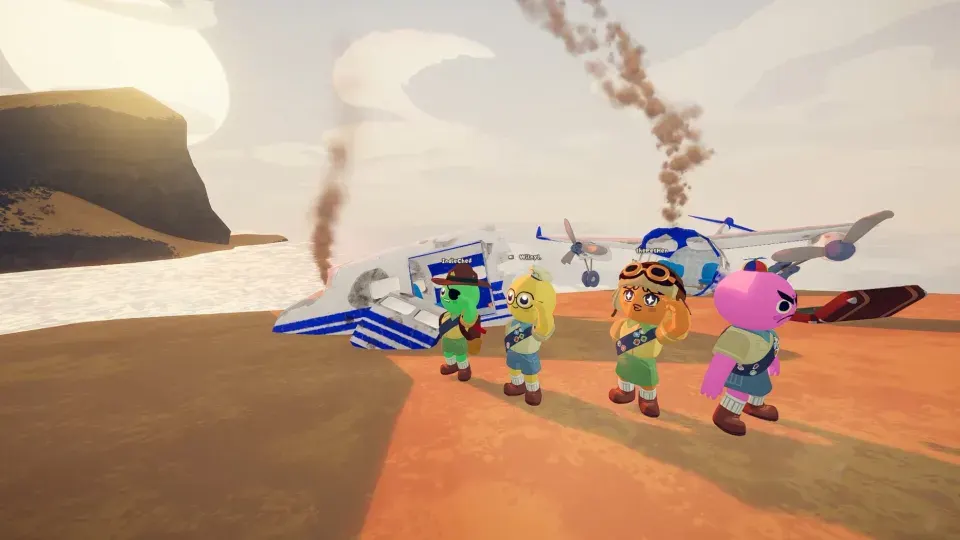
There's an ongoing divide about the word "friendslop." The genre descriptor, born of games like Lethal Company, Peak, and many others in recent years, can be used in both positive and negative contexts, which can make it confusing. Personally, I was trying to reserve the "-slop" suffix for things made by generative AI, but the term has broken containment and is now used widely in conversations about co-op games of a particular type: light on mechanics, welcoming to a wide array of skill levels, and heavy on the opportunity for social hijinks and proximity chat-based laughs, friendslop games aren't going anywhere.
But should we be calling them that? Do the teams making such games find it demeaning? I recently spoke to a handful of studios making games in this vein, and for the most part, they actually seemed okay with it. However, the sentiments they shared with me often had an air of acceptance rather than excitement.
"Once the kids are using it, I think you have to just go with it," Developer Mike Boxleiter told me earlier this summer when I first demoed Lazy River, his co-op game about building a raft to survive a water park overrun by zombified patrons. The "kids," I took him to mean, are Gen Z, and perhaps more specifically, TikTok users. Once they've adopted the term and are using it as broadly as they are, there's no putting the toothpaste back in the tube. "It's been hitting me a little harder because we put out a trailer, and it blew up a little bit. And a lot of people got really negative about 'friendslop,' like using it really pejoratively."
The duo at Beck & Branch Games, Michel Strömbeck and Nikolai Nyqvist, recently put out Grain Rot, a REPO-inspired co-op game that reimagines the experience with base-building. Strömbeck and Nyqvist told me that while they don't use "friendslop" internally, they understand what players mean by it: "games with a low barrier to entry, a tight replayable loop, and chaos that turns into fun with friends." It doesn't seem they take offense from the term, but it's notable that neither do they use it.
Kaleb Alfadda, Blake Reible, and Jon Reilly of Scythe, the team behind Happy's Humble Burger Cult, told me they "don't necessarily avoid" friendslop as a term. On the contrary, they've "come to embrace it," because it usually--though they admit not always--means a "'multiplayer game focused on one fun concept,' rather than 'a garbage game.'”


Similarly, Bandit Trap's Michael Balm said his team at Picomy is "not opposed" to the label and knows it caught on because it's an "easy way to describe a certain style of social multiplayer game." But the questionable suffix gives Balm pause.
"The only part we're a little hesitant about is the word 'slop,' because it can suggest these games are simple or low effort," Balm said. "In reality, many of them are incredibly well crafted to create fun, chaotic moments between friends. We wanted [Bandit Trap] to be easy to jump into, but we also put a lot of care into the art, mechanics, balance, and all the little details that help create those memorable moments with friends."
For Koro Games, the team behind Friendly Steps, the term presents a shortcut to find new players. Developer Vlad Koro told me via email, "We’re used to and enjoy making larger-scale games, and for us, the emergence of friendslop is an opportunity to expand our audience."
Yet not everyone is as eager to accept the term, even if it does have its perks. Dwarven Brothers, the studio behind We Are So Cooked, told me that the team has avoided it for the most part. "We like to associate our game with 'friendlike' to give it a more positive-sounding tone," the two-person studio told me, "but we cater to the friendslop genre by using this descriptor sparingly."
Of the seven teams I spoke to, I'd categorize only one of them as enthusiastic. Ukraine's Oleksandr Mikulonok, Nikita Vakhnichenko, Diana Lynnyk, and Rostyslav Mykhailyk, of RetroStyle Games and Last Pirates: Die Together, told me they "love" the term, believing whatever derogatory intent that it might have been created with has been wiped away as it's been reclaimed by the community.

"It started as a jab and the community wore it as a badge, same as roguelike or boomer shooter before it. We use it internally all the time: Our whole competitive research is basically a list of games that steal your evening with friends. If players call Last Pirates friendslop, they got exactly what we promised. Better to be top-shelf slop than forgettable polish."
Whether teams love it, avoid it, or have simply accepted it, it's unlikely to go away. Just ask folks who take issue with genre labels like souls-like, metroidvania, walking sim, or JRPG. Despite their efforts, these terms have persisted, embedding themselves in gaming culture as shorthands for a type of experience players may be seeking or have enjoyed before. Like Exorcist Hotline's Hexateam told me, "The name is secondary as long as it gets the point across: it being a fun game to play with friends, with a lot of shitposting. We use [friendslop] because it’s easy."
It started as a jab and the community wore it as a badge
While "friendslop" isn't yet a sortable label on platforms like Steam, the number of games in this vein currently being developed is too numerous to count easily, and, arguably, developers working in this space could benefit from such a label on storefronts. Is discoverability more important than what sounds to some ears like an insult?
If there was going to be a new term to replace this one--my colleague Claire Lewis suggests "bro-op," for what it's worth--it would likely have to happen very soon, before friendslop is all but cemented in gaming lexicon for decades to come. And if developers making these games are perhaps conflicted but overall content to accept it, then it's very likely here to stay.