Marvel Snap Is Finally Getting A Draft Mode, And It’s Unlike Any You’ve Played
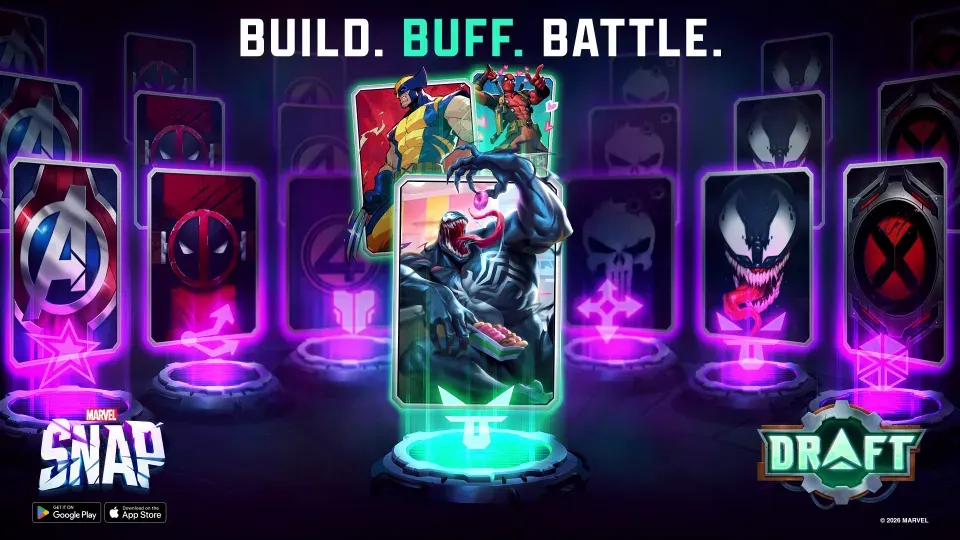
Marvel Snap has been a huge debut success for Second Dinner, the studio created by Blizzard alumni. But if one feature has been missing since launch, it's that mainstay of card games: a draft mode. Snap is finally preparing to launch its own spin on Draft with a new mode coming Monday, August 24, and GameSpot got an exclusive first look.
Draft will be a Limited Time Game Mode (LTGM) at launch, similar to other modes like Grand Arena, Team Clash, and Sanctum Showdown. That means you'll have tickets to play, as well as a reward track for participating in the mode. And while it's more recognizable within the standard rules of Snap than some of those other modes, it also carves out its own space with some unique twists on the regular rules of a Draft mode.
When you begin Draft mode, you pick a Starter for your deck--three cards that synergize together from a variety of recognizable archetypes like Ramp, Swarm, Move, Destroy, Control, and Ongoing. Then you build the rest of your deck with individual card picks, categorized into those archetypes. Second Dinner noted that Marvel Snap is an unusually synergistic game, so it needed to make sure players could draft a deck that works well together. That's the purpose of categorizing cards into these specific card pools. Cards have also now been given a rarity status, like Rare or Legendary, to help steer how often it will come up as an option in the card selection.

During the initial draft phase, you'll immediately notice that cards here are sometimes a little different than you recognize. For one, they may be given enhanced stats, making them more powerful than their standard incarnations. You can also have duplicates in Draft mode, so having a card in your deck doesn't necessarily mean you won't see it as an option anymore. Finally, some cards may be given Augments, powerful upgrades like Quickdraw Discount that reduces the card's cost by 2 on the turn it's drawn; Amplify, which doubles a card's Ongoing effect; or Superstar, which guarantees the card starts in your opening hand.
You draft until you've made a deck of 10 cards and then you start battling. You'll play until you either win five matches or lose two, but you do have the option to use one Respawn Token per Draft round. As you play matches, you'll get the option to add more cards to your deck (up to 12) or to enhance your current cards with more Augments, further empowering you to take on more challenges.
I had a chance to go hands-on with the Draft mode, building decks and battling it out with bots and likely Second Dinner employees, since I wasn't yet in a live environment. And while I've never been too enamored with Draft modes in other card games, this one caught and kept my interest thanks to the smart ways Second Dinner has iterated on the concept.

The new type categories make a huge difference in building a synergistic deck. Giving you a Starter pack with three cards really helped steer me towards a particular play style, and then it was easy to maintain that with subsequent draft selections. Not every choice was a perfect fit--naturally in a Draft mode you need some randomness and things won't always line up--but choosing an archetype as my Starter created a North Star for me to follow for the rest of my selections. The new rarity ratings had a similar steering effect, as sometimes I would break from my deck type to take advantage of a powerful Legendary card, trusting that its sheer quality would still make it worthwhile. Plus, if a card didn't fit exactly into my deck, I could always bank the chance of outfitting it with a great Augment that would make it work. Or I could use Augments to turn my already-powerful cards into destructive powerhouses.
Like any card game, Marvel Snap's Draft mode sings when it lets you create unexpected combos that feel powerful and even game-breaking. I'm traditionally a Destroy player in Marvel Snap, so I gravitated toward that for some of my Draft matches. I had drafted a Bucky Barnes, which drops a Winter Soldier when it gets destroyed. But then I got the opportunity to augment Bucky with Regeneration, giving him the Wolverine-like ability to revive and bounce to a different location with +2 power. I cackled at this wombo-combo as I repeatedly destroyed Bucky, leaving behind a Winter Soldier and respawning him elsewhere to do it again. After a few hours of hands-on time, I don't think I've really scratched the surface of these surprising scenarios.
For more insight on Marvel Snap's new Draft mode and how the studio iterated on a classic card game type, I spoke with Second Dinner's Sam Stoddard.

GameSpot: The two big pillars of Marvel Snap are Ranked Mode and Conquest, plus rotating LTGMs. In the foundational stages, when you were first conceptualizing having a Draft mode, why did you go the LTGM route instead of trying to make it a third pillar?
Stoddard: Part of the reason why it's taken so long to get Draft into Snap is that if you were to design a game where it was basically impossible to do a Draft mode, Snap would be pretty high up on the list. Like, it's just got a lot of things that are working against how you would normally do a Draft mode.
Snap has a much lower number of cards, you have very small decks, so even the amount of variance you get isn't super high, as well as the synergy is very high. There's all these things that were really working against it, and it's part of why it took so long to eventually get to a place where we were really happy with what we had as an offering.
And so part of the LTGM thing is that we have a lot of known unknowns right now. I enjoy the mode a lot, but I designed it. I've talked to a lot of other people who enjoy it, but we definitely need to really stress test it with a much larger group of people.
The thing that we cannot do is change two-thirds of the cards every time we run the draft. There just aren't enough cards in Snap to do that. But we can do things like change which Augments exist or change what decision nodes you get. You know, some of the core rules of what you're doing.

And so all those are options for what we can do, and we really want to make sure that basically whatever we're offering for this mode, it is as fun as possible and it's not something that's going to become stale very quickly. And that's the one of the major things that we're going to find out, I believe, when we launch it. How long are people able to play this and able to reasonably get a lot of enjoyment out of it, be able to play new games, try different things? There's a lot of things we're just going to learn over time.
So based on how this LTGM goes, both with this initial rollout and subsequent versions, is there a chance it becomes permanent? Is that something that you're keeping an eye on?
It's definitely something we're keeping an eye on. There are a lot of discussions about that. I'm not sure exactly where we're going to land on it. Certainly, there are goals to make sure that Snap as a whole has a lot going on with it, and that we have everything that we need, but I think we're just basically going to figure out over time what the right spot for this is. We'll find out over time what the right exact cadence for the mode is.
Marvel Snap is a very synergistic game, more than even most other card games. And so, when making a Draft mode, you need to make sure that people can actually build a deck that functions, and isn't just like a bunch of random stuff that doesn't really work together.
Yeah, this is another big problem when we were designing it, was that that is the main problem, "Oh, I got a Colleen Wing. Okay, well is that any good?" Well, if I don't get at least like three discard enablers or discard rewards, then no, that card is just not worth it.
As we were looking at it and trying a lot of stuff out with the mode, that was always the problem. The question I always had was, "Okay, how do you beat something like Black Panther / Arnim Zola?" Like, you got a two-card combo that puts a bunch of power in two lanes. How do you beat that? In the regular game, well, I have different synergies or my deck's trying to do something slightly different.
If it's just based on, well, you don't really have a lot of synergy in my deck, it's more based on how strong cards are individually, then where you're really going to struggle. And just, frankly, Snap just doesn't have a lot of cards that are super strong by themselves. They really mostly rely very heavily on synergy.

So when I was designing, some of it is we have the ability to add Augments to thing make it so that you can take a card that doesn't necessarily fit into your destroy deck and put an Augment on it that ties into destroy and now, all of a sudden, it does fit in your deck.
I always refer to it like aim assist, right? You play a shooter on a controller, and obviously, you don't have the same level of fidelity as you would on a mouse and keyboard. And so there's there's a certain amount of aim assist that you put on, so it's like, you know, you don't necessarily want it to be like, "Oh, it's I can move between my different lock-ons." That's not really fun.
What you really want to do is something where I start going down a strategy and it's going to be more likely to feed me cards that are going to play into my strategy and give me some options to pivot, rather than, "Okay, well you that first pick standard destroy card, and then like I just saw no other destroy cards for the rest of my deck, and now I just my deck's not very fun."
If synergy is the secret sauce of Marvel Snap, that can also get way out of hand if you let people over-synergize.
Another thing that Marvel Snap does that makes it difficult for Draft is we don't have hard rarities. You know, inherently in the game, we've got different "Series" of cards, but that's not really the same thing as card rarity as most games do. So, it was actually kind of nice. We got to just invent the rarities for cards. And so we got to say, "Oh, well, this card is a Common, this card is a Rare, this card is an Epic, this card is a Legendary."
And so some of it is that we get to move stuff around in rarities. So, if we're saying, "Well, destroy is just too strong right now," we can always move something like Carnage or Venom and go, "Well, instead of being, you know, a Common, now this is going to go up to Rare." Or take one of the, "Oh, well this card that was a low rarity just shows up less frequently, and we pick some other card that maybe isn't quite as strong and move it down in rarity so we can kind of try to power balance things that way."
We don't necessarily want every strategy to be equally strong. Some strategies are going to be more consistent. Swarm is a good example of a deck where, as I'm laying out all the stuff, it's like, "Well, how many cards do we have that, you know, are destroy enablers?" It's like, "Well, there's like, 10 or something. There aren't that many." Well, how many cards do we call, you know, swarm enablers? Well, that's every card in 1-cost cards, so there's 150 or something.
And so there definitely was a lot of, "Okay, we need to move some stuff around and figure out, some decks are going to be more consistent than others, some decks are going to be a little more, power-spiky, sometimes the strategy's going to play really heavily into one synergy, sometimes it's going to do different things."

It's actually one of the reasons why discard is not in. We found a lot of spots where many of the other decks like Move or Destroy, they could make sense pretty easily. Like if you have like one or two move cards in the deck, that can still work. Or like, "Oh, there's some combos and stuff I can do with it," where discard is very much, "Okay, if you're not really pretty all-in on discard, then all of these cards are not very good."
You could potentially have more than one copy of a card, which is not a thing you can normally do in Snap. How did that come about?
Designing the mode, that was always one of the most important things to me, was being able to play multiples of the same card. One is that there are a lot of it evens out a lot of the synergy across different decks, where some decks are going to be more reliant on a small package of like, you know, enablers and payoff cards. And letting you play duplicates means that you don't have to have like the same three or four individual enablers and payoffs in the same deck.
You can have the move deck that is much more based around, "I'm going to play two Kravens, so I'm going to bounce cards between those two locations to get them large." Or I've got, you know, Multiple Man or something like that. That lets you have a lot more variety between the individual games because there are all these duplicate versions of cards.
For a Draft mode to function, you also need the low roll. "Oh, none of these really work for my synergy. I guess I just pick the one that seems like it's least bad." That's part of how this mode has to function. How did you try to make sure that that element was in there, but didn't feel so bad that it is off-putting?
Some of that is the Augments and giving you opportunities to upgrade cards in ways where you can take something that maybe wasn't very exciting and it becomes exciting.
One of the other key tenets for me on this was, Marvel Snap does a lot of really interesting things for the whole CCG genre. It really tried to turn a lot of things on its head, and a lot of that is the average game length in Snap is just very, very short. That's intentional. It's intentional that it's a very mobile-first, bite-sized experience.
If you play a lot of other draft games, a full draft run, that might take hours. And especially on a mobile, you know, for a mobile game, that's not necessarily a thing we want to sign people up for.

So my goal was, obviously, we'll let you play one game at a time and you can, come back later and finish your draft. But also that the entire time it takes to kind of go all the way in a run should be like under half an hour. And so that also helps out with some of the low rolls. Trying to make sure that the actual experience is fast and fun enough that you are willing to take those risks because, you know, even if it goes poorly, you're only out a minimal amount of time and you can jump back in and try again. That was really important.
I also need to ask, obviously, about the Augments. That's a huge element that can almost feel game-breaking. When did that come into the flavor of this mode?
I'm someone who is a drafter at heart for most card games, so I definitely had in mind, "Okay, one of the things I want to do at some point is figure out how we get drafting in." And, I knew it was going to be really difficult because obviously it's not like the people [at Second Dinner] had not figured out that draft should exist, so obviously it was going to be a challenging design problem.
And when I first got that ability to really start prototyping it, it was with just duplicates and, you know, that was really it. And so like as we were testing it, it's like, "Okay, there's something fun here, but it's not actually enough." Like the only way we'd really make this work would be if we have so few cards that you can reliably expect to get duplicates, and then it's like, "Well, how many times can you really draft the three-four deck before that kind of gets old?" And so okay, we're not really quite there yet.
Augments came out of an idea partially just because one of the things that is challenging about getting Draft in Snap is that when you do a draft, part of the fun is you get to make a lot of decisions. If it was like a Smash Up game, "Choose deck A and deck B, mash them together, and you've got a deck." Well, that might be a fun experience, but it's not a draft.

And as we were testing out drafting, part of the issue was, you weren't getting enough decisions to make it really feel like drafting. It was like you got to make a couple decisions, but it wasn't enough. And Augments became a way of, "Hey, what if we added in the ability to kind of like upgrade or change your cards?" That goes a long way to giving you more decision space.
And also, again, goes into the the eventual goal as a live service--that we're able to do some changes and and have it come back and have it feel different, being able to change what Augments exist goes a long way to, "Oh, things feel very different this way because, now there are more Augments focused on some different strategies." Or "Now some of the Augments are more about reducing costs or more about something different," and that goes a long way to having each [iteration] run it at different times and each of those runs feel pretty unique without having to reinvent a card pool--which is, again, difficult because there's a small card pool.
Behind the scenes, how will that cadence of updating and planning for the next version of the Draft LTGM work?
We have not fully figured that out yet. Everyone is very, very excited about the mode, but we obviously are looking to see how the audience reacts. Whenever I'm designing anything, audience feedback is incredibly important. I don't want to be the like "the kids are wrong" guy where it's like, "Oh, you know, we we believe in this, and we release it, and people are kind of meh, and so we're just going to keep releasing it the same way until until like they realize how good it is."
There's a lot we're going to learn. The number of draft games that we played internally is going to be dwarfed by the number of draft games that happen in the first hour that it's live. So, we will learn a lot. We're going to learn a lot about how much choosing different strategies plays out. We're going to get a lot of data that way.
Definitely a thing that we will be trying to figure out from all that data is what that cadence looks like. It's not going to be too long before it comes back because we definitely have a lot of things that we want to try out.

Long term, I think we're just going to have to figure out some of this. How fresh does it stay for the time that it's up? What do we need to do between instances to make sure that it is remaining fresh, and that we've got a lot of new stuff to do?
We want to make sure that we don't hit a point where it always gets stale because we just don't have enough stuff going on. So, we're definitely going to figure out what happens with our initial run, and as we do subsequent ones, figure out what we change between runs, how much does this add on to it.
Draft has probably been one of the most requested modes in Marvel Snap. And Draft is sort of a standard mainstay of card games, but the way you're implementing it is really surprising. I don't know what I was expecting from Draft, but there are more wrinkles in this than I had anticipated. So, when you're looking at what the demands have been from the fan base, how do you make sure you deliver while also packing in like a bunch of surprising wrinkles that I don't think people are going to see coming?
That's been a huge point of discussion between us, internally. "Does this hit your expectation for drafting in Snap?" And certainly, we've had versions of this previously where it felt like, "This does not live up to what my expectations would be because it's like, whether it's just not very fun, or some versions where we've tried different configurations like, "Well, what if you started by drafting, three cards and then you got a bunch of two-card picks?"
And it was like, "Well, I"m just not making enough picks. It doesn't feel like a draft format. It feels much more like a mashup thing." Certainly some people are going to want a more traditional draft experience, whether it's, "I want to play more games at a time," or "I want to play more directly against another person."
I'm sure that there will be people where this does not necessarily hit exactly what they are or exactly looking for. The general hope is that this mode is fun and, much in the way that Snap took a lot of things that core CCGs did and turned them on their heads and, there are trade-offs that we made to make it this really fun mobile experience that is very different from other CCGs.
If you take all the things that Snap has done that are unique and really think about [Draft] in the same way, what can we do that really makes this unique in a way that lives up to Snap's DNA of the game?