Wingspan Pocket Card Game Review
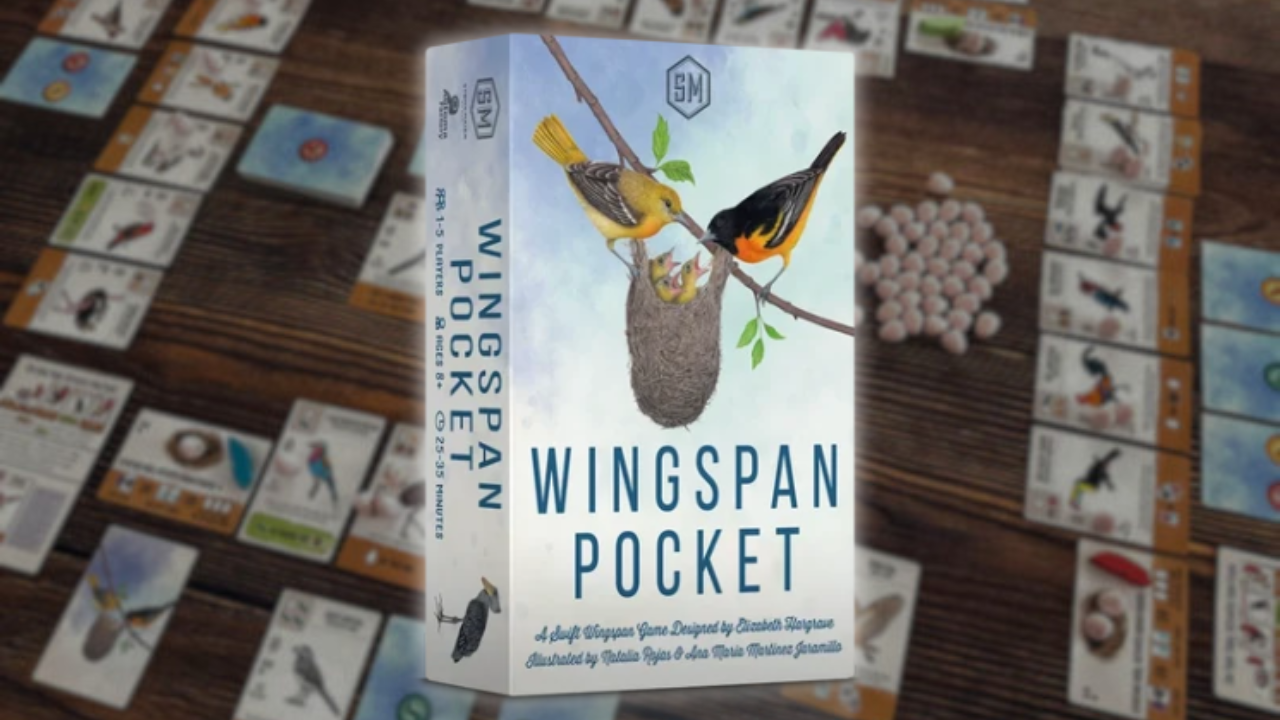
You’ve probably heard of Wingspan, the multi-million selling game of bird ecology that introduced a whole new audience to the strategic delight of engine-building games. But however widely appealing the theme of the game might be, it presented a significant barrier to new players in the form of rules overhead. There’s a lot to learn in the game, and a lot more to master.
This new game, from Elizabeth Hargrave, the same designer as the original, aims to slash that barrier down by presenting many of the same mechanics in a convenient, bite-sized box. As we saw in our recent review of Diplomacy: The Golden Blade, however cleverly you cut down a game, there’s a risk you’ll lose what made it special.
What’s in the Box

Half of the box is taken up with a stash of resin eggs which will be instantly familiar to fans of the original game. These are all one base color but they compensate with a variety of freckles and speckles of pattern, making them look surprisingly realistic. Rooting around in the eggs, you’ll also find a packet of wooden feathers, one color for each player.
The other half is filled with cards. Mostly this is one giant deck of bird cards which will, again, look very familiar to Wingspan veterans, featuring a similar layout and, in many cases, the same bird with the same artwork, although the mechanical details are different. Some cards do have all-new art, and there are also some birds that are entirely new to this edition. Whatever the provenance, the bird pictures remain a delight, full of detail, life and movement.
In addition to the bird cards there are some player aids, a nest card for each player, and some smaller decks. One is an automaton for solo play, another, of smaller, fiddly cards, has a series of goals players try to complete during the game.
Rules and How It Plays

Cards in Wingspan Pocket are double-sided. On one side there’s a food symbol for things birds like to eat; on the other is a bird itself. Players get dealt six cards and get to decide which two of them they’re going to hold as birds, with the remainder being kept to play as food. The rest of the cards are divided into four and the top card flipped off each stack and kept face up. There’s thus a selection of four different birds and four possible foods to choose from.
Each player also gets a nest card with an egg token on it and the card details one of three actions they can take on their turn: play a bird from your hand, take cards, or place eggs. Each bird has a cost in specific foods and, sometimes, eggs as well, and you’ll need to have these available to pay if you want to take the first action, after which you lay the bird to the right of your nest. Otherwise, picking up cards lets you choose any two from the selection of food or birds as you like, while the egg action lets you place eggs on three different cards.
Most birds have some kind of special power which is often related to their real-life behavior or ecology. The nefarious common Cuckoo lets you place an egg on another of your birds. The ghostlike Snowy Owl lets you draw a bird at random and tuck it under the owl, becoming a prey item, if its wingspan is under 100cm. The extravagantly named Turquoise-Browed Motmot gives every player the chance to blind draw a food card. Once you have any birds in play you use a feather token on your turn, moving from your cards from left to right and instituting that effect in sequence. First the nest with its choice of actions, then each bird’s special power.

In this way you are essentially creating an engine, like a much simplified version of the three-habitat engines that characterize the original Wingspan. Once you have birds in play that provide food or eggs then you need to take those actions from your nest less often, meaning you can put birds into play faster. It’s an optimization exercise, but there’s a surprising amount of nuance from this simple setup. In your initial selection, for example, it’s helpful if you can have one of the birds you’ve kept provide a resource that helps you play the second. And it’s strangely satisfying when your bird line-up clicks into gear.
What you’re really aiming for is some kind of combo between the bird powers in your line up. The Kookaburra, for instance, lets you pick a fish or mouse food type for free so it combines brilliantly with the Inca Tern or Secretarybird which let you discard those food types respectively to gain two cards of your choice, meaning you’ll never have to waste nest actions taking cards again.
There’s a surprising amount of nuance from this simple setup.You can try and specialize in particular resources, or go for a broad base. And as your hand of available bird and food cards change, you’ll need to be constantly revisiting your strategies to keep things in line. Waiting to see if the food or birds you want to extend your strategy are going to be available in the selection when your turn rolls around is surprisingly exciting.
The game ends when one player gets six birds in their row, at which point you flip your nest card over and it becomes a handy track to tally your points. Each bird card has a points value printed on it, with more expensive or less useful birds being worth more points. You also get a point for each egg and each tucked card. In the advanced version of the game, which you’ll want to use after your initial grapple with the rules, there are also two goal cards in play which reward you with additional points for having eggs on birds that meet their printed criteria. Worth three or fewer points, say, or having a wingspan over 66cm. The whole game takes just 10-15 minutes per player.

Goal cards are important because they significantly enrich the strategic decisions in building your engine. Birds that meet one or both criteria are obviously more valuable and you have to balance the need to acquire and play them with the utility of special powers on birds that don’t fit the bill. Given that you only get six birds maximum in a game, the margins on these decisions can be wafer thin. It can also sometimes be frustratingly random if you just never get the chance to grab good or high-scoring birds when they’re available, or find complementary powers to create a good engine. Them’s the breaks, but it’s far less annoying in this half-hour package than it would be in a longer game.
The whole game takes just 10-15 minutes per player.If you’re familiar with the original, the truly striking thing about Wingspan Pocket is how successfully it recreates the feel and basic strategies of the original in a fraction of the complexity and play time. It’s a masterclass in trimming fat, from the clever way cards act as both food and birds, removing all the rules around the original’s food dice while retaining the seed or randomness, to the way birds synergize effectively in one row instead of three habitats. Sure it’s less strategic and skillful overall, but the improvement in convenience and accessibility is so huge that it’s easily a worthwhile price to pay.
