Voidling Bound Review
Evolution of the Creature Collector
Developed by a studio made of ex-Skylander developers, Voidling Bound is presented as a creature collecting game combined with third-person shooter. While the player can collect and build creatures called Voidlings, combat involves directly controlling them, fighting alien parasites that threaten humanity and Voidlings alike.
Voidling Bound takes place in the far future where humanity now lives all across the galaxy. The Lesion, alien parasites that corrupt the places they inhabit, have begun to spread, wiping out human colonies. The Lesion seems to be unstoppable until the discovery of Voidlings, creatures with the ability to rapidly adapt and evolve to combat threats. People called Wranglers are trained to go “Voidling Bound”, connecting their minds with their Voidlings to go out and fight the Lesion directly. The player is a new Wrangler, and accompanied by a crew of characters to assist them, flying through the galaxy and seeking a way to destroy the Lesion once and for all. Beyond this initial setup, the game’s story is thin. The Wrangler is told where to go and a vague reason why, and there is little else. The other characters accompanying the player are little more than shop stalls aboard the ship, as they are given little characterization or backstory beyond their introductions. Voidling Bound‘s core concept feels ripe for further exploration, but the game itself is entirely incurious about its own ideas. While not an active detriment to the gameplay experience, it is disappointing to see such potential go to waste.

As opposed to most other creature-collectors, players directly control their Voidlings.
Gameplay is split into two halves: combat missions where the player fights the Lesion as a Voidling, and downtime on a spaceship as the Wrangler. On the ship, the player can explore, speak to other characters, and interact with their collection of Voidlings. The rest of the ship’s crew are there to support the Wrangler’s mission: Rachael provides mission selections, Henry covers the care and breeding of Voidlings, Michael handles training Voidlings, and Leon is in charge of evolving Voidlings and bringing out their full potential. The training is especially welcome, as it solves the problem in many other creature collectors of leveling up a large number of creatures quickly. Here, players can just assign Voidlings to the appropriate training plan, and they will be boosted to a higher level in only a few minutes. This cuts down on a huge grind that becomes a major roadblock in many other games.
The majority of a player’s collection will be in storage, but there is a Vivarium at the back of the ship where up to eight Voidlings from the party can wander around. They climb up on rocks and logs, and sometimes take a nap, and the player can pet any Voidling that is out on the ship. It would be nice if there were a few more interactions available; even just the option to toss a ball and play catch with Voidlings would help build that bond that is supposed to be important. The Vivarium is also where the egg incubator and breeding nests are. Voidling eggs are collected during missions, sometimes hidden in out-of-the-way places. After returning to the ship, the eggs are taken to the incubator which will instantly hatch them. Each egg is guaranteed to hold a Voidling of a specific species, though they can hatch with an additional passive that gives a small boost to one stat. The hatching animation has an oddly gacha-like feel, but the outcomes are largely predictable and editing a Voidling through splicing is far more important, meaning breeding Voidlings is done purely to raise their base stats. This is only important in the endgame, as the main campaign can be completed with any normal Voidling. The Abyss, however, will quickly demand higher stats that are unachievable on the first generation of Voidlings. Several rounds of leveling up and then breeding one species of Voidling is required to hit that maximum. Breeding ends up being busywork the player has to complete to optimize their Voidlings.
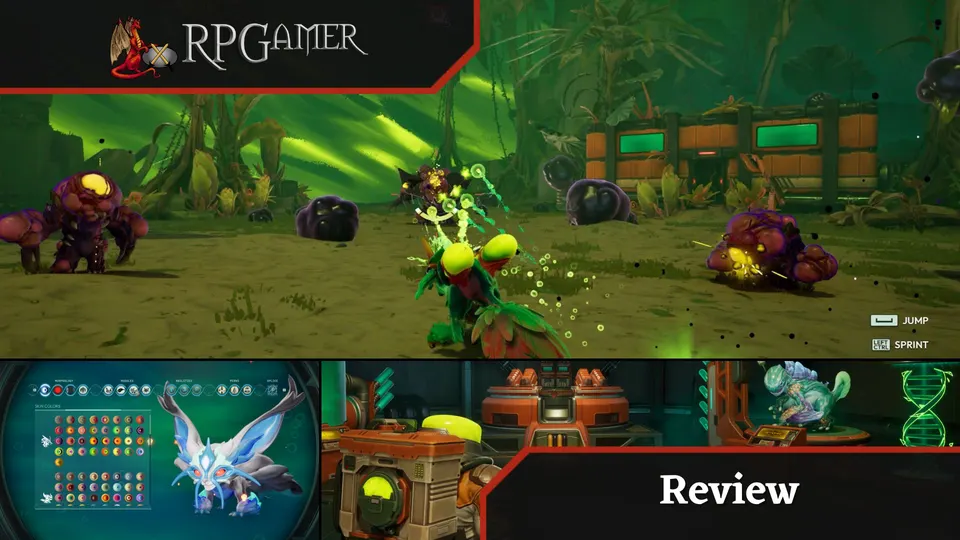
Elsewhere on the ship there is a lab with three stations: the Evolution Chamber, where an individual Voidling can be evolved; the Cerebrum Enhancer, in which the player can spend points to fill out a per-species talent tree for each Voidling; and, lastly, the splicing station, where Voidlings can be modified and customized. Each Voidling species has two major branching evolution paths, which unlock cosmetic options as well as additional abilities and passives for that creature. All of these are added to a gene library that the player can use once the splicing station is unlocked. The splicing station is where the game’s creature collection side truly opens up. It allows players to build their own Voidling, combining the different abilities for that Voidling, and passives collected across all species, to create powerful builds, as well as customizing its appearance. This is the reason the player will want to collect every Voidling evolution, in order to collect all the available passives and cosmetic options to build their perfect Voidling. That can be in any manner, whether being perfectly optimized to go deep into the Abyss, or just something silly. If the player wants to build a Voidling that damages enemies by being stinky, that is absolutely possible. The splicing station has few limits, and the player’s Voidling storage is generous. The game wants the player to experiment and have fun.

The splicing station allows a wide range of cosmetic and gameplay options for Voidlings.
The combat is where Voidling Bound shines brightest. Each Voidling species has its own distinct combat style: for example, the Kwipek is a bird-like Voidling that’s a fast but fragile gunner; the Nimiod floats above the battlefield, zapping anything below it; and the Morfang is a pure melee Voidling, dashing towards its foes ready to shred them. There is an emphasis on movement in combat; staying still is a surefire way to get killed, but so is running around the arena blindly. Learning what each Voidling’s strengths are and how to play them is an important part of the learning curve. Once the player has that understanding, combat is smooth and satisfying. Each Voidling’s ultimate ability also has some slow-motion added to the animation, just enough to help aim during a chaotic fight, and to add some extra flair to the battle. Each mission is linear with different objectives along the way. Sometimes the objective is as simple as clearing multiple waves of attackers, while others will require the player to defend an area or destroy Lesion growths. There are also bonus rewards for finding every egg on the map, and for completing a level quickly. It does not add much replay value to the missions, just a little something extra.
There are two parts to the overall structure of the game: the campaign, which takes place across four different zones, and the endgame Abyss, a gauntlet of increasing difficulty meant to challenge the Wrangler’s ability to raise and fight with their Voidlings. The campaign takes the player through leveling to the max level of 20, introducing every species of Voidling along the way. It has both required and optional missions, and enough mission types to keep the gameplay interesting. The Abyss is intended not just for max-level Voidlings, but ones that have been fully invested in and optimized. The Abyss will reward effort invested; the more the Wrangler experiments with different builds and the more time put into breeding the perfect Voidling, the deeper and more rewarding the Abyss will become. The more experimentation, and the more creative a player is with its systems, the more the game rewards them.

The Abyss can get chaotic at higher levels.
The game’s visual design is bright and colorful, in contrast to areas infected by the Lesion, which are covered in globs of dark purple gunk. The game will take the player across three planets and the Abyss, all with their own unique aesthetics and exploration mechanics. Though once at the endgame, there is little to no reason to go back to the older planets, and the Abyss uses only its own assets. The environments from the other planets feels severely underutilized, which is a shame because all the maps have lovely visual design. It is a shame they become obsolete as soon as the player finishes that planet. The quality of Voidlings’ design varies. For the most part, they are fun and inventive. On one end is the Gilick, which is just a lizard. It can gain some dragon-like horns, but it never stops feeling like a generic reptile, especially in comparison to other Voidlings that have stronger themes. On the opposite end of the scale is the two-in-one Ur-Sek, composed of the ursine host Ur and the insectoid parasite Sek. It is a fresh creature design that perfectly reflects its stance-switching gameplay. Each Voidling comes with a large collection of cosmetic variations, from different body parts to eye colors to body patterns. Some are usable across species; for example, it is possible to give the cute little monkey compound insect eyes. All the different options fit well together; rarely is there an option that looks like it does not belong on that Voidling, regardless of which species that look first came from. It is evident that a great deal of thought and care went into the creature designs and making sure all the different options worked together. The game’s music is pretty average except for the main theme, which recurs as a leitmotif throughout the soundtrack. It’s fun to catch that melody in different tracks. Beyond that, the music gets the job done without much fanfare.
While Voidling Bound does have shortcomings, they’re overshadowed by what’s great about the game. The game’s flaws are more about unfulfilled potential than something fundamentally broken. It is also a game that inspires and rewards creativity in its players, which will determine how much a player gets out of the experience. The gameplay is fast-paced and exciting, with a wide variety of creatures and abilities to choose from, keeping things fresh through both the main campaign and the endgame. Voidling Bound is a delightful and inventive twist on the creature collector, and one worth checking out.
Disclosure: This review is based on a free copy of the game provided by the publisher.
Scores BATTLE SYSTEM
INTERACTION
ORIGINALITY
STORY
MUSIC & SOUND
VISUALS
BATTLE SYSTEM
INTERACTION
ORIGINALITY
STORY
MUSIC & SOUND
VISUALS

Great combat system
Splicing is cool and fun
Appealing visual design
Story premise is underutilized
Short campaign could keep players engaged for longer
The post Voidling Bound Review appeared first on RPGamer.