Palm Sugar: A Village Story Review
The Good Fight
While some RPGamers prefer gameplay to story, I tend to be on the opposite end of the spectrum. I love getting lost in worlds that are not my own, and the more compelling the characters, the more likely I am to stay for the long haul. Mono Tusk Studio’s Palm Sugar: A Village Story is a world unlike my own. I am a person with privilege, whereas the characters in this story are not. They are trapped in a powerless system where corruption reigns, and every individual craves power as a means to end the poverty that enslaves them. However, while Palm Sugar‘s rich narrative excels, its gameplay falters due to its simplicity and stiffness.
The story begins with a young man named Seenu in jail, learning that someone has paid for his bail. The other inmate asks Seenu how he ended up in prison, because rumour has it that he “murdered” someone important. Seenu shares his story with the stranger, recalling his life before his crimes. A boy in love, Seenu falls for the free-spirited Geetha, whose father is a politician within their village of Bellampakam. After Geetha leaves for the city, she returns home to Seenu waiting for her, but their village has changed for the worse. As the two walk back to Geetha’s home, they are attacked by gangsters. When Seenu fights off the gangsters, he kills the brother of a member of the local drug cartel. This action ends up as a ripple effect throughout, as Seenu must defend his friends, family, and villagers from the drug cartel, which has been poisoning the residents.

So many chickens to feed to the wild dogs around town.
For such a short game, clocking in at an hour and a half to complete, there is a lot of story tightly woven together. There are moments of pure cruelty and violence that show the corruption surrounding Seenu’s village. The shock value in these moments, though painful, truly heightens the sense of how dangerous Bellampakam is and who is in charge. The game’s themes of love and grief are the centre of this story, and it is one where, although Seenu must participate in heinous acts to solve the mystery behind the cartel, there is a lot of nuance regarding Seenu’s actions throughout the story, his relationship with Geetha, and what happens when one attempts to play hero in a world where corruption corrupts absolutely. While the game begins as a love story, it’s also one that is melancholy: while it’s clear the two love each other, they are from two completely different worlds and schools of thought. Seenu is an idealist, and Geetha a realist, in a place where people are barely getting by, and wealth is difficult to claim without one getting their hands dirty. Palm Sugar‘s narrative is cruel, compelling, and effective, as it asks players to look beyond their privilege to see the grey that exists within our world.
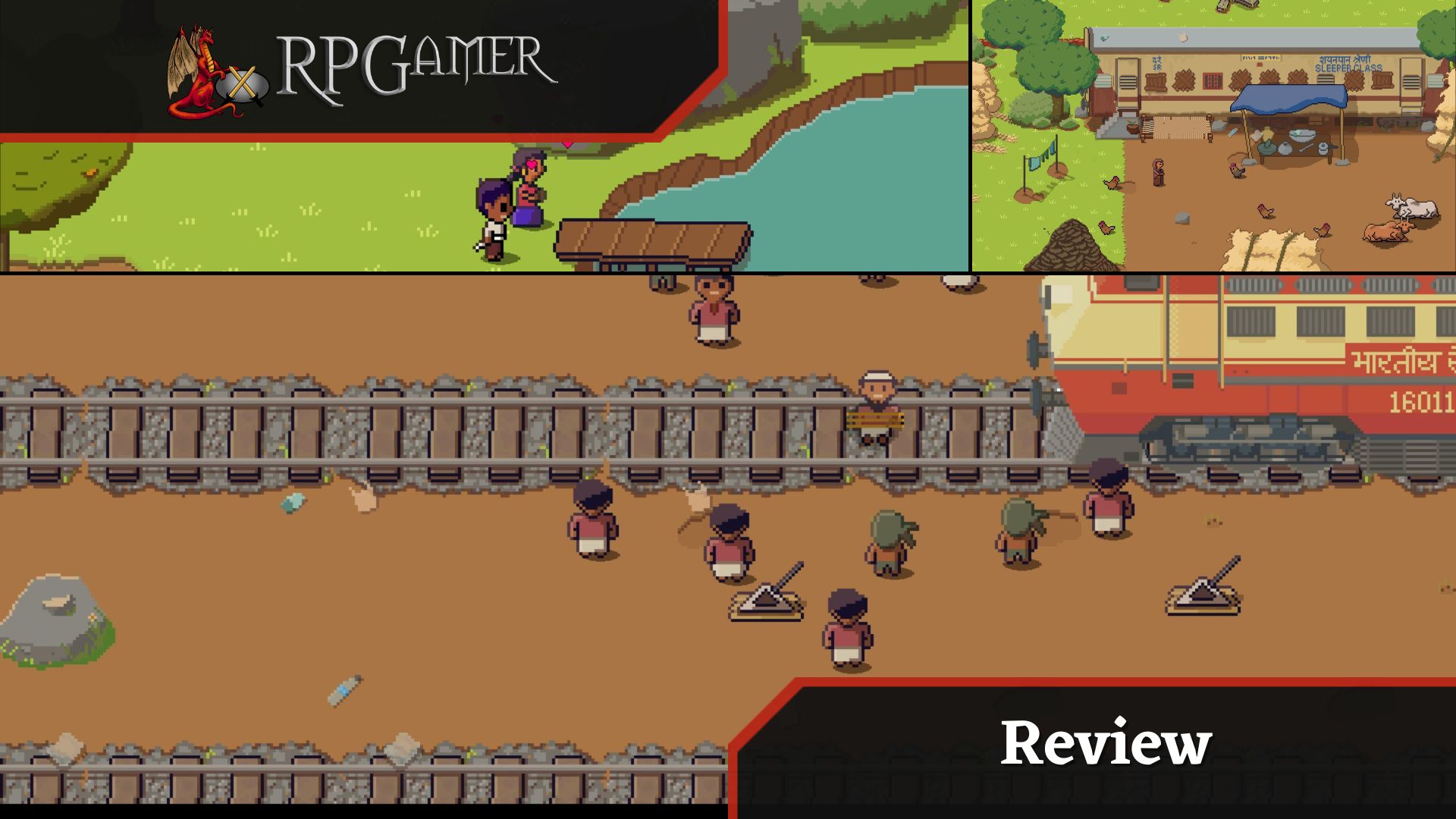
Unfortunately, the rest of the game lacks the same amount of complexity and depth that the narrative offers. Beyond the story, most of the game has Seenu exploring the villages in search of the cartel, with only two side quests to partake in, both of which add a nice layer to the overarching story. Beyond these two moments, Seenu spends most of the game defending himself from gangsters, throwing grass at cattle and goats to move them out of the way, and slingshotting mangoes out of trees for health replenishment. The action-based combat involves Seenu using weapons such as slingshots, sticks, and axes to defend himself from hordes of enemies. It’s never one enemy coming at him, more like five to ten at a time, with Seenu swinging his weapon awkwardly to try and hit the whole group. Combat with the axe and stick feels very clumsy, and while Seenu can dodge, it’s not that useful. Using the slingshot is a different challenge when dealing with hordes of enemies because while it does knock them down, it’s still easy to become overwhelmed when lining up a shot. The controls are also not particularly intuitive with a controller, as it’s easy to accidentally hit the wrong button when it comes to switching weapons or using health items, meaning some game overs will simply occur because the combat is often working against the player.

Is Seenu a hero or a murderer? You decide.
While the combat in general is lacking, more specific blemishes are harder to ignore. In numerous moments during our playthrough, the game would switch between the player having three hearts for health, to four, and then back to three. This would occur whenever the player dies, meaning players will not know how many hearts they actually have in combat. While game overs do not punish the player and merely take them back to the last checkpoint point, it’s hard to know how much health one will have. It’s an element of the game that absolutely needs to be ironed out, as it makes for an unbalanced difficulty and unpredictability. There were also instances of items being glitched after pickup, wherein they would be stuck in the environment, making it unclear as to whether Seenu has picked the object up or not. These issues detract from the game’s overall performance, adding more frustration throughout.
Palm Sugar offers a wonderful soundtrack that is deeply rooted in South Indian culture. It’s very atmospheric, and works well during the game’s many tense moments. The game also has a narrator for most of the story, and while it’s good, the audio mixing of the voice and music isn’t consistently on the same level, meaning the narrator’s voice will often come in louder than the music or vice versa, creating some audio incoherence. Visually, the game is very simple in its approach, with important characters having distinctive elements within their design. That being said, throughout the game, whether it’s in a cutscene or during exploration, every character’s expression is hollow-looking and somewhat eerie. It’s an interesting design choice, but not particularly effective when enemies fall to the ground like crumpled paper.
If I am being completely honest, I wish Palm Sugar: A Village Story was less of an RPG and more of a visual novel. The gameplay elements spend more time harming the overall experience, taking away from what makes the story so captivating and strong. Between the constant gameplay issues and the game’s boring combat, it makes me wonder why any of it was included in the first place. There is a great story and world within Palm Sugar, but given its many issues, it’s hard to recommend, even if it’s mercifully short.
Disclosure: This review is based on a free copy of the game provided by the publisher.
Scores BATTLE SYSTEM
INTERACTION
ORIGINALITY
STORY
MUSIC & SOUND
VISUALS
BATTLE SYSTEM
INTERACTION
ORIGINALITY
STORY
MUSIC & SOUND
VISUALS

Interesting story
Decent music
Short
Clumsy combat
Glitches aplenty
The post Palm Sugar: A Village Story Review appeared first on RPGamer.